
A Step-by-Step Guide to Custom Engagement Rings:
You already know what you want to say. You have thought about the moment, the setting, the words. What you have not figured out yet is the ring. Not because you have not tried, but because scrolling through identical mass-produced styles at chain stores has left you with the same unsettled feeling: none of them look like her.
That is exactly where custom engagement ring design starts. Instead of choosing from what is already made, you work with a master jeweler to create something that did not exist before. A ring built around her style, your story, and the craftsmanship that makes it last a lifetime.
This guide walks through how the custom engagement ring design process works in Knoxville, from the first consultation to picking up the finished piece, so you know what to expect and what decisions you will need to make along the way.
Why Do Couples Choose a Custom Engagement Ring Over a Store-Bought One?
The short answer is that a custom ring fits better in every sense. The style fits her taste instead of a category. The metal, the stone, the setting, the proportions, all of it is built around what she actually wants rather than what happened to be on display.
There is also the practical side. A custom ring is made to her exact finger size from the start. No post-purchase sizing adjustments that can stress the metal or affect the setting. The ring is built right the first time.
Research from The Knot’s 2023 Jewelry and Engagement Study found that nearly 40 percent of engagement rings now include some form of customization. That number has climbed steadily as couples look for pieces that feel personal rather than mass-produced. Working directly with a jeweler means every decision, from the stone to the setting to the band, is made intentionally rather than pulled from existing inventory.
What Happens During the First Consultation?
The first meeting is a conversation, not a sales pitch. At Rick Terry Jewelry Designs, the consultation is where the jeweler listens. He wants to know about her style, the kinds of jewelry she already wears, whether she gravitates toward vintage or modern, whether she prefers yellow gold or white, whether she has shown any rings to friends or saved anything that caught her eye.
You do not need to come in with a clear vision. Some people arrive with screenshots and a Pinterest board. Others come in with nothing more than a general direction. Both are fine. The jeweler’s job during this stage is to help you translate what you know about her into a design language he can work with.
This is also where you discuss your vision openly. A skilled jeweler will not push you toward the most elaborate option. At Rick Terry, the goal is to help you get the best possible ring for your situation, which sometimes means recommending a different stone shape that reads larger on the hand, or a setting style that lets the center stone take center stage.
How Do You Choose the Right Diamond or Gemstone?
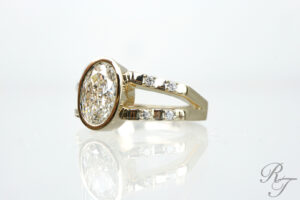
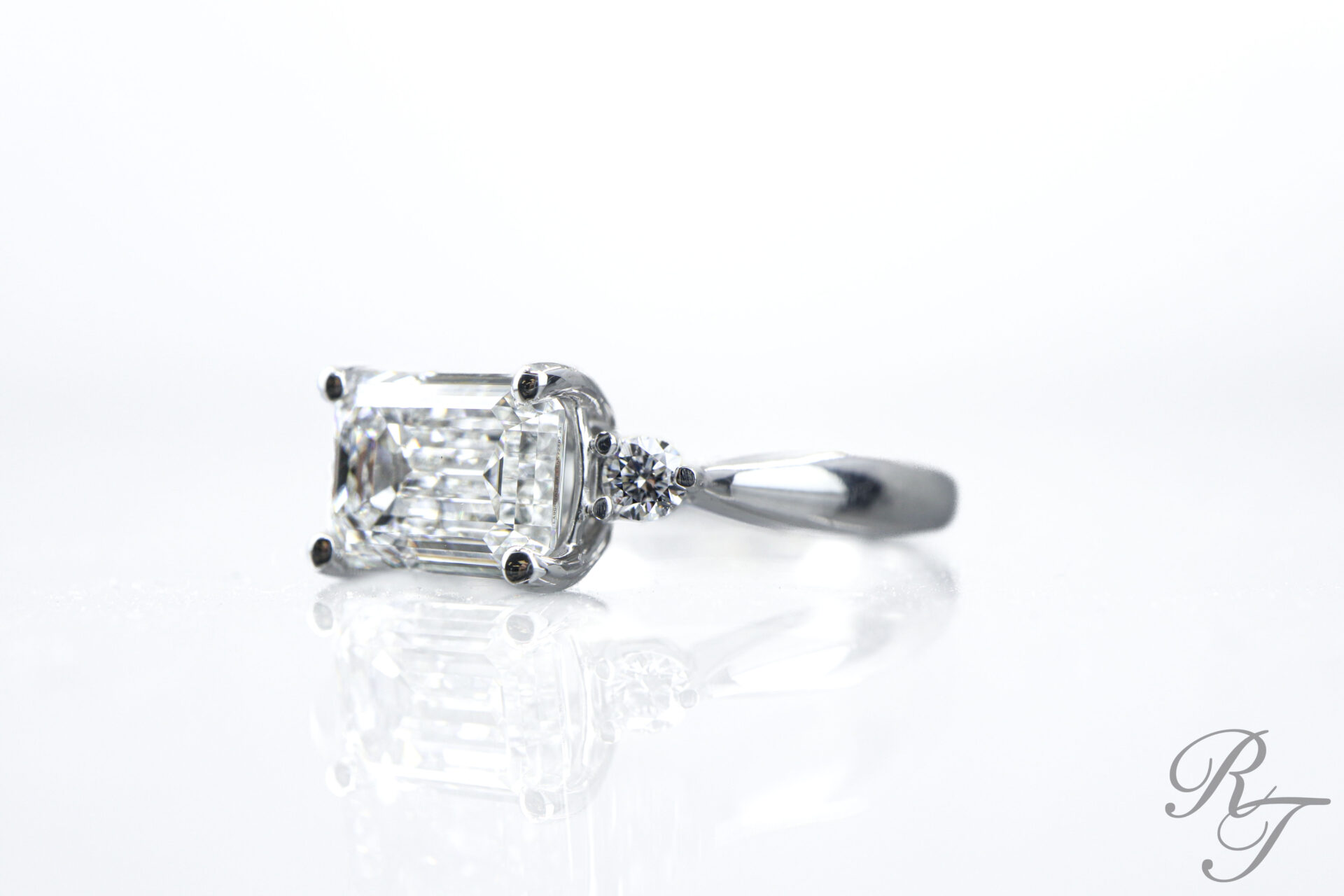
The center stone is the heart of an engagement ring, and the options extend well past the traditional round brilliant diamond. Oval cuts are enormously popular right now because they elongate the finger and create a distinctive silhouette. Cushion cuts have a soft, romantic look. Emerald cuts are architectural and bold. Pear shapes make a strong statement. The shape you choose shapes the entire look of the ring.
For couples who want a diamond, the classic four Cs apply: cut, color, clarity, and carat weight. Cut is the most important factor for how a diamond performs in light. A well-cut diamond will outsparkle a poorly cut diamond with better grades on paper every time. The gemologist at Rick Terry can walk you through what each grade means in practical terms so you understand exactly what you are looking at.
All diamonds and gemstones at Rick Terry Jewelry Designs are locally and responsibly sourced. This matters to many couples, particularly those who want to know that their stone was not extracted under harmful conditions. The practice has held to this standard since 1986, and it is not a marketing checkbox. It is how the business operates.
Colored gemstones are also a real option for engagement rings, not a compromise. Sapphires, particularly blue and the increasingly popular teal variety, are extremely durable and sit just below diamonds on the hardness scale. Morganite has a warm peach tone that photographs beautifully. An emerald, if selected carefully for its clarity, makes an exceptional center stone. A gemologist on staff can walk you through the specific properties of each stone type so you understand exactly what you are getting.
What Metal Should You Choose for the Band?
The metal sets the tone for everything. Yellow gold reads warm and classic, and it pairs beautifully with diamonds in the near-colorless range because the gold absorbs some of the color instead of reflecting it back. White gold is rhodium-plated, giving it a bright, contemporary look, though it does need re-plating every few years as the rhodium wears. Platinum is the most durable option and maintains its white color permanently without the need for replating.
Rose gold has remained popular for over a decade because it photographs well and has a romantic quality that works in both vintage and modern settings. Two-tone bands, combining yellow and white gold for example, can add visual interest without competing with the center stone.
The width of the band, whether it is flat or rounded underneath, whether it tapers toward the setting or maintains a consistent width, all of these details get discussed during the design phase. Nothing is arbitrary. Every decision is intentional.
What Does the Design and Fabrication Process Actually Look Like?
After the initial consultation, the jeweler creates a rendering or sketch of the proposed design. At Rick Terry, all design and fabrication work is done in-house, in Knoxville. Nothing is sent out to a third-party manufacturer. This matters because it means the jeweler who discusses the design with you is also the person building it. There is no translation loss between what was agreed on and what gets made.
You will review the rendering and have the opportunity to request changes before any metal is cut or any stone is set. This is the moment to speak up if something looks off. The proportions of the band, the height of the setting, the exact placement of accent stones, all of these can be adjusted at the rendering stage far more easily than after fabrication begins.
Once the design is approved, fabrication begins. For a custom engagement ring, this process takes several weeks, depending on complexity. The timeline is something to discuss during your consultation, particularly if you have a specific proposal date in mind. Most jewelers will tell you to allow more time than you think you need.
What Should You Expect When You Pick Up the Finished Ring?
The pickup is not just a handoff. You will have the opportunity to inspect the ring in detail, look at the setting under magnification if you want to, and confirm that everything matches the approved design. At Rick Terry, the finished piece is cleaned and presented with full attention to detail.
At this stage, the jeweler will also walk you through care instructions specific to your ring’s metal and stone. A diamond set in a prong setting needs periodic inspection to confirm the prongs are secure. A sapphire can be cleaned differently than an emerald, which is more sensitive to ultrasonic cleaners. Knowing how to care for the ring from day one protects your investment.
Rick Terry Jewelry Designs also offers a maintenance plan for ongoing care, regular cleanings, prong inspections, and refurbishing over time. For a ring this important, long-term care is worth thinking about from the start.
How Do You Get Started?
The process begins with a single conversation. Rick Terry Jewelry Designs has served Knoxville couples since 1986, and the approach has not changed: listen first, design second, build with care. Whether you are three months from a proposal or three weeks out, the first step is the same.
Book a consultation at rickterryjewelry.com or call the studio directly to set up a time. Come with whatever you have, screenshots, descriptions, a general sense of her style, or nothing at all. The conversation will take it from there.
Frequently Asked Questions
How long does it take to design a custom engagement ring in Knoxville?
Most custom engagement rings take four to eight weeks from the approved design to finished piece, depending on complexity. If you have a firm proposal date, discuss it at your first consultation so the timeline can be planned accordingly. Rushing the fabrication process can affect the quality of the finished ring, so earlier is always better.
Is a custom engagement ring a good option if I have a specific vision in mind?
Custom is the best option when you have something specific in mind that you cannot find in a store. It is also a strong choice when you want complete control over the materials, the sourcing, and the craftsmanship. At Rick Terry, the process is built around your vision, not around existing inventory. The jeweler works with you from concept through completion, and nothing gets made until you have approved the design.
Can I use a family stone or heirloom diamond in a custom ring?
Yes, and this is one of the most meaningful ways to approach a custom engagement ring. Bringing in a family diamond or stone and building a new setting around it combines the sentimental value of the original piece with a design that fits her style. The stone will be evaluated by a certified gemologist before any work begins to confirm its condition and suitability for the setting you have in mind.
What if she wants to be involved in the design process?
Some couples come in together from the start. Others prefer the ring to be a surprise and do the design work solo. Both approaches work well. If you want her involved, the consultation can include her directly. If you are planning a surprise, the jeweler can work from the information you provide and the approved rendering.
Does Rick Terry Jewelry Designs only work with diamonds?
No. The studio works with a full range of gemstones, including sapphires, morganite, emeralds, rubies, and others. All stones are responsibly sourced. If you are interested in a specific stone type, bring that up at the consultation and the gemologist can discuss the properties, durability, and visual qualities of your options so you can make a well-informed choice.
What happens if something needs to be adjusted after I receive the ring?
Rick Terry Jewelry Designs stands behind its work. If a prong needs attention, the ring needs sizing after delivery, or anything requires adjustment, the studio handles it. The maintenance plan covers ongoing care over time, and the team is available for questions after the ring has been picked up.
